



Montenegro is well on its way to joining the EU. There have also been positive developments recently at Ulcinj Salina, but the permanent administrative structure still needs to become fully operational, and the conservation measures must lead to measurable environmental improvements.
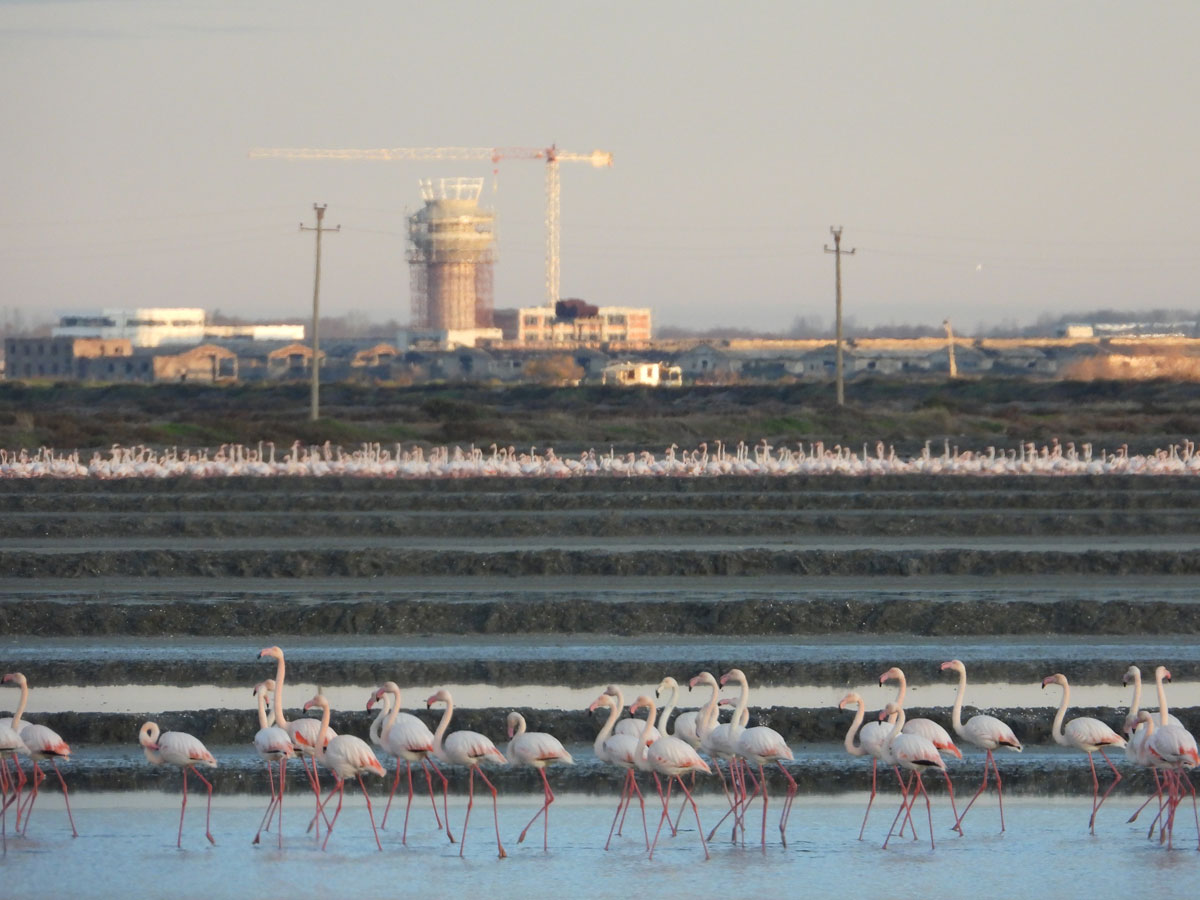
Flamingos in the Narta Lagoon near the Vlora Airport construction site. The planned tourism projects in the region are an environmental scandal.
© Zydjon Vorpsi/ PPNEA
The latest plans sparked massive protests in spring, the largest protests in the country since the end of the communist dictatorship.
© Beka PhotographyBrussels, Podgorica, Tirana. The EU Commission’s 2026 Enlargement Package comes at a decisive moment for EU enlargement in the Western Balkans. Montenegro and Albania are moving fastest towards membership, making the credibility of environmental conditionality in both countries especially important.
While progress has been made in aligning legislation with the EU acquis, the decisive test, however, is whether accession produces measurable improvements for nature, governance and citizens, as required in Chapter 27 (Environment and Climate Change). Chapter 27 tests not only whether the environmental legislation is aligned with the EU framework, but whether that framework can be implemented and enforced in practice. (see analysis of both country reports below).
“Montenegro has earned recognition for its progress. But closure of Chapter 27 cannot mean that unfinished obligations become less important once negotiating leverage is gone,” said Viktor Berishaj, Senior Policy Officer at EuroNatur. “The last phase before membership must make them concrete, measurable and enforceable.”
“In Albania, environmental governance has become a test of democratic governance,” said Gabriel Schwaderer, Executive Director at EuroNatur. “The EU Commission knows where the problems are. Reporting them again is not enough, the accession process now has to show that its conditionality can solve them.”
The EU should translate the findings of its own Enlargement Report into clear, measurable Chapter 27 conditionality. Progress must depend not only on adopting legislation but on showing that environmental safeguards influence real decisions.
The frontrunners will set the standard
Montenegro and Albania are at the front of enlargement. If significant implementation gaps remain unresolved as chapters close, or clearly identified deterioration does not trigger stronger conditionality, the credibility of the process will suffer far beyond these two countries.
Montenegro: provisional closure must not leave the obligations open
Montenegro has made important progress under Chapter 27. Its proposed Natura 2000 network covers 50.97% of the country’s land area (as well as its governance structure, both of which remain under the Commission assessment), new nature-protection legislation has been adopted, river-basin planning has advanced and steps have been taken towards resolving the long-standing management problem of Ulcinj Salina.
But important obligations remain unfinished. Montenegro still needs to complete alignment with the Birds and Habitats Directives, and effective implementation before the accession. Its proposed Natura 2000 network is still undergoing scientific assessment for possible insufficiencies which may rise during the current assessment period, while its governance and management system is not yet fully operational.
At Ulcinj Salina, a management plan and roadmap for permanent management are welcome, but the permanent management structure still needs to become operational and conservation measures must deliver measurable ecological improvements.
Persistent wastewater and pollution pressures affecting the Zeta River provide a concrete example why plans and aligned legislation alone cannot demonstrate that the Water Framework Directive is working in practice. Known pollution sources must be addressed through monitoring, enforcement and remediation. Administrative and inspection capacity also remains incomplete.
EuroNatur calls for full Birds and Habitats Directive alignment before accession, addressing of outstanding Natura 2000 insufficiencies, zero tolerance for deterioration of proposed Emerald and Natura 2000 sites before formal designation, operational management of Ulcinj Salina, effective implementation of the water acquis, including action on pollution affecting the Zeta, and sufficient inspection and administrative capacity. Major infrastructure affecting high-value natural areas must remain subject to rigorous preventive environmental assessment before irreversible decisions are taken.
Albania: the Commission has diagnosed the problem, now the accession process must act
Only a little more than a year has passed since negotiations on Cluster 4, including Chapter 27, opened in September 2025. Yet implementation in several areas fundamental to environmental governance and enforcement deficiencies have led to deterioration in nature protection.
The Commission’s assessment is unusually clear. Albania still needs to substantially improve alignment with and implementation of the EIA and SEA Directives. EIA quality remains inadequate, monitoring weak, public participation limited and enforcement insufficient. On nature protection, urgent progress is required on the Birds and Habitats Directives, while the 2024 amendments to the Law on Protected Areas and extension of the Strategic Investments Law have weakened nature protection.
These are no longer abstract accession problems. In Pishë Poro–Nartë, development permits and preparatory works have advanced amid serious concerns over environmental assessment, transparency and participation. Construction of Vlora International Airport has continued despite repeated yearly requests from the Bern Convention, since 2023, for an adequate new environmental assessment, while development pressure also continues in Buna–Velipoja.
The dispute over protected areas and strategic development has also become part of a wider governance crisis. Mobilisation over Narta, environmental protection and governance was followed by broader protests, largest civic mobilisation since Albania’s democratic transition, centred on corruption, education, economic opportunity and political accountability. Failures in public participation, transparency and institutional accountability cannot be treated merely as technical Chapter 27 shortcomings.
EuroNatur calls on Albania to restore safeguards weakened by changes to protected-area and strategic-investment legislation, namely, to repeal the Amendments to the Protected Area Law 21/2024, to terminate the Strategic Investment Law and to repeal the so-called Mountain Package. Furthermore, EuroNatur demands from Albania to complete the transposition and enforce implementation of EIA and SEA directives, ensure meaningful public participation and access to environmental information, protect Emerald sites and future Natura 2000 areas before formal designation, and fully implement Bern Convention Recommendation No. 219 on Vlora Airport and Vjosa–Narta.